Read Full Report of prepare by Geohimachal here.
India is rapidly increasing electricity generation from solar and wind power. These sources are clean, but they are not available all the time. Solar power drops at night, and wind power changes with weather. To keep electricity supply stable, the grid needs a way to store energy when production is high and release it when demand rises.
Pumped Storage Hydropower, commonly called PSP, is currently the most reliable large-scale energy storage technology in the world. It works like a giant water battery. When electricity is surplus, water is pumped uphill into a higher reservoir. When electricity is needed, the stored water is released downhill to generate power again. ( See this also )
Why Himachal Pradesh is often seen as ideal for PSP
Himachal Pradesh is a mountainous state with deep valleys, steep slopes, and many rivers. Because PSP depends on height difference, or elevation drop, mountain regions are often considered naturally suitable. This is why Himachal Pradesh appears frequently in discussions on future pumped storage projects. However, high mountains alone do not guarantee good PSP sites. What really matters is where large elevation differences occur over short distances, and whether water can realistically be diverted between two points.
What this study looked at
This study focused on the Beas River, one of the major rivers flowing through Himachal Pradesh. Instead of examining one or two proposed sites, the entire river course was assessed to understand how elevation changes along its length. The goal was simple: to see whether the Beas River naturally offers locations where pumped storage projects could work efficiently.
What the study found
The Beas River shows a large total drop in elevation from its upper reaches to downstream areas. At first glance, this looks promising. But when the river is examined continuously, a different picture emerges.
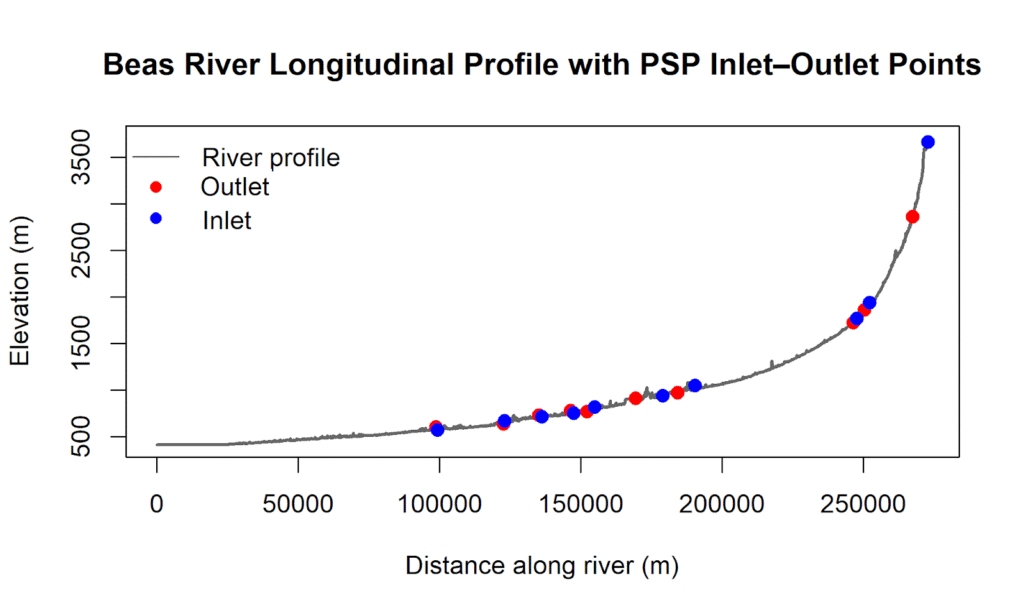
Most of the elevation drop along the Beas River is spread out gradually over long distances. This means the river does not often create sharp, concentrated drops that are ideal for pumped storage. In many places, achieving a useful height difference would require very long tunnels, which increases cost, risk, and environmental impact.
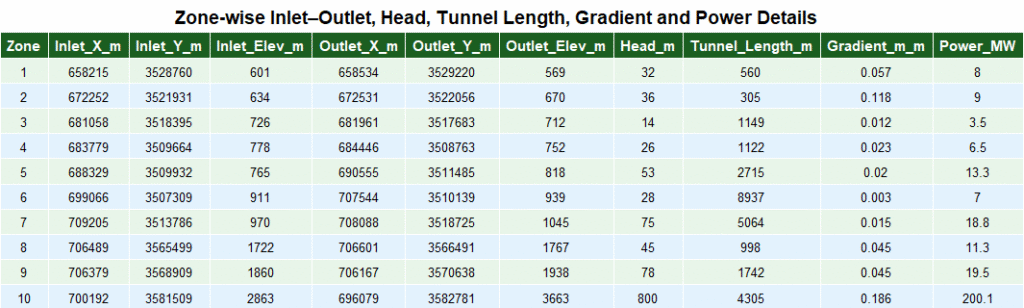
Only a small number of locations along the Beas River show relatively concentrated elevation drops. Even in these areas, terrain constraints and tunnel length remain important challenges.
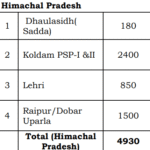
Table-1, Showing the latitude, longitude, Elevation , Gradient and Power of Each Inlet-Outlet Point.
What this means for pumped storage in Himachal Pradesh
The findings suggest that pumped storage potential in Himachal Pradesh needs to be evaluated carefully, river by river and basin by basin. Not every mountain river is suitable, and not every steep valley can support an efficient PSP project. The Beas River is better suited for conventional hydropower than for large pumped storage schemes. This does not mean PSP is impossible in Himachal Pradesh, but it does mean that suitable locations are fewer than often assumed.
Why this matters for planning and policy
Pumped storage projects involve large investments and long construction periods. Identifying weak sites early helps avoid costly mistakes. A broader, evidence-based view of river systems can guide better decisions before projects move into detailed planning.This kind of river-wide assessment helps policymakers, planners, and researchers focus attention on locations with genuine potential rather than relying only on local impressions.
Final takeaway
Pumped storage hydropower remains a crucial part of India’s clean energy future. Himachal Pradesh will likely play an important role, but good sites are limited and must be chosen wisely.The Beas River study shows that careful evaluation is essential. Big mountains do not automatically mean big energy storage potential. Understanding the river as a whole makes all the difference.