British took over the charge of Kangra in 1846. British surveyed the Land , fixed the value and allow the cash transaction. They slowly replaced the Barter economy with Cash economy. By 1860, most economy of Kangra was cash Based. Unlike other part of country, British did not make radical change in hill economy, as rule in hill was difficult. They allowed the local king ,zamindar and other feudatory to continue extract the revenue of Land.
Nature of Economy and Economics Division of Kangra
The regional economy of Kangra was based on old Feudal system. Kings was top on the ladder followed by Jagirdar, kins, assignee, maafidar etc. Agriculture was the backbone of the economy. For administrative Purpose Kangra was divided into 8 parts viz. Kangra, Nurpur, Hamirpur, Dera, Kullu sub division, Kullu proper, Lahaul and Spiti.
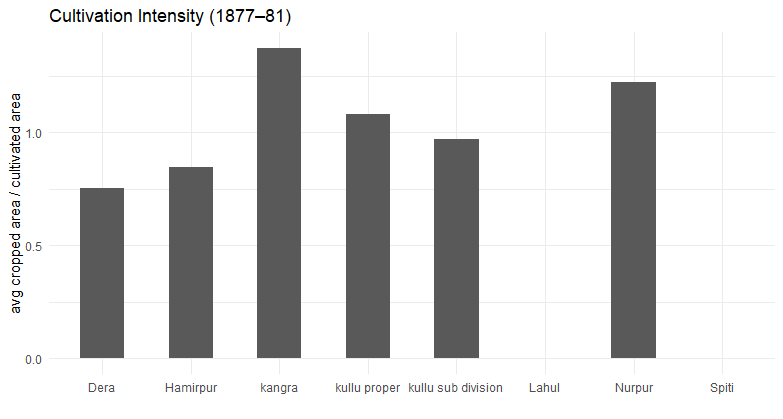
Kangra was among the most important division division of British empire around 19% of Kangra area was cultivated and around 95% was all cultivated land was irrigated. Besides it Kangra faced high pressure of cultivation ratio between average crops are to cultivated are is 1.38.
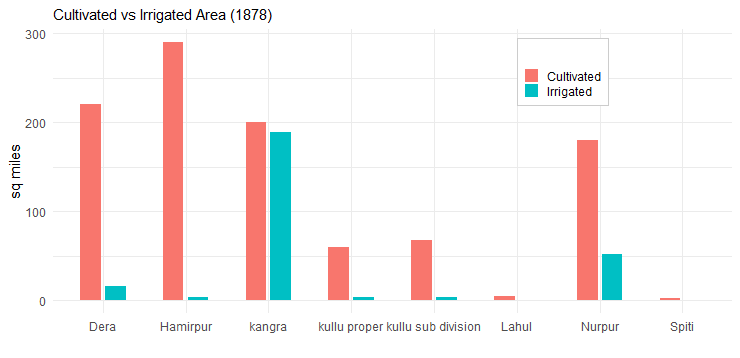
In Nurpur, Hamirpur and Dera approximately 35% . 45% and 44% of total area was cultivated. However only approximately 5% area was Hamirpur and Dera irrigated, In Nurpur 29% of cultivated land was irrigated. These division faced very low cultivation pressure.
In Kullu valley only 2% of total area was cultivated and around 4% of cultivated Land was irrigated. Land was often abandoned and face very little cultivation pressure. There were very negligible cultivation in Lahaul and Spiti.
Land Revenue Collection
In Revenue collection hierarchy Raja was at the Top, he owned large patch of Land, extraction rate was medium but due to high land , Raja was able collect large share of revenue.
Subordinated Jagirdar also hold good land parcel but comparatively smaller than Raja, however extraction of Jagirdar was higher than Raja, so they manage to extract handsome revenue.
Kins of Raja also hold small portion of Land but their extraction rate was higher and enjoyed lot of privileges. Similarly various assignee, Maafidar etc also hold very small land with minimum extraction rate.
Mode of Revenue Collection
Bat(Share) was original method of revenue collection. Here payment is in Grain not in cash, if production is low both share Raja and farmers share the loss.
Chakota ( Grain /Cash) was a fixed amount is paid every year, regardless of output. Harvest may change, payment does not, entire risk shifts to cultivator. Cash-only revenue here cultivator must sell crops to pay revenue and Even grain is converted to cash value.
Single piece of Land may attract all kind of extraction. Farmers were main producer but they left with very little produce for themselves. For Example: Rs 100 grain Produce, Raja get 35 Rs, Jagirdar 20 Rs, Kinsmen Rs 15 other 20 Rs and farmers left with only Rs 10. Whole economy was very unproductive just like today, very little manufacturing very high trading.
Who were the Farmers
Table:- 1 , Showing Landholding of Different Caste in British Kangra in the Beginning of 20th Century.
| Sub-division | Brahman (%) | Rajput (%) | Girth (%) | Total (%) |
|---|---|---|---|---|
| Palampur | 21.0 | 38.1 | 9.1 | 68.2 |
| Nurpur | 12.6 | 75.1 | 2.5 | 90.2 |
| Dehra | 17.7 | 57.0 | 14.3 | 89.0 |
| Hamirpur | 23.6 | 65.0 | 12.7 | 101.3 |
| Kangra | 11.5 | 27.1 | 33.1 | 71.7 |
A small portion of Brahmin and Thakur/Rajput also cultivate, but top most producer were Ghrit (spelled as Ghirath/Choudhary) , who were the main cultivator. Together Brahmin,Thakur and Ghrit controlled 90 % of Land of Kangra proper (excluding Kullu and Spiti ) by the end of 19th century. Rajput were main Landowner in controlling up to 75 % Land in some area such as Nurpur, Brahmin controlled 23.6 % Land of Hamirpur and Girth in Kangra controlled 33.1% land. These Land division does not necessarily show systematic exclusion of other castes, but definitely remaining caste were left with very little resource to survive. Present settlement pattern of villages of Kangra valley can also be explained with these Landholding evolution.
Advent of Cash Economy and Changes
By 1860 Britisher Began to replace the barter system with cash system. The new sytem not only changes the Economy but the society itself. Earlier all payment are made in kind but now Farmers were asked to pay in cash, it increases the importance of Merchant caste like Sood and Khatris.
Farmers need cash to pay to government whether output is good or not. When the farmers couldn’t pay back the moneylenders, the British legal system facilitated the transfer of land from the debtor to the creditor. This was Golden period for merchant class, many new trading castes migrated from Plain to hills. British viewed the trading classes as “stabilizing elements and the power of Raja decreased significantly
Tea Plantation in Kangra
One major change in the Kangra economy was introduction of Tea Plantation in 1852 by Dr. William Jameson. A large numbers of Tea estates were setup in Palampur , Bir, Nagrota Bag wan and Dharamshala. Here again merchant class benefited a lot. Many families became the local partners or “Managers” for European tea planters. Over time, they used the wealth and connections gained from these positions to buy out the European owners or to acquire surrounding village common lands (Shamlat) that the British had categorized as “available for development. Even today one can find Sood/Khatris hold very large patch of land in Palampur, Nagrota Bagwan and other regions of Himachal Pradesh.
Decline of Agriculture
Fertile Kangra Valley with abundant water resources and large number of Farmers was nothing less than Gold mine. However over the year Land Productivity Decreases sharply in District in 1851-52 Land Revenue was 8,11,522 it decline to 6,15,053 in 1871-1872 and stopped increasing further.
At the same time, non-land sources increased. Excise from spirits rose sharply by 1861–62 and 1871–72. Income from opium and drugs also kept rising, especially by 1881–82. This points to tighter state control over intoxicants and their growing role in revenue.Stamps show the clearest growth. From a small amount in 1851–52, stamp revenue became very large by 1881–82. This reflects expansion of courts, paperwork, land records, and legal transactions under colonial administration. Assessed taxes appear only later and increase by 1881–82. This shows new forms of direct taxation being introduced gradually.
Table-2 :- British Revenue Source.
| Year | Land Revenue (Proper) | Land Revenue (Fluctuating) | Excise (Spirits) | Opium and Drugs | Assessed Taxes | Stamps | Miscellaneous |
|---|---|---|---|---|---|---|---|
| 1851–52 | 8,11,522 | 6,307 | 11,468 | 3,528 | – | 5,029 | 3,644 |
| 1861–62 | 7,83,986 | 3,565 | 27,453 | 7,752 | – | 19,995 | – |
| 1871–72 | 6,15,053 | 8,608 | 31,903 | 8,755 | 5,855 | 44,404 | – |
| 1881–82 | 6,13,480 | 3,009 | 18,701 | 14,358 | 7,170 | 66,791 | 4,204 |
Source of Article : Kangra Gazetteer 1883-Part-1
Written By:–Pardeep Kumar, Author of Book Himachal Pradesh Geography through Maps and The Kangra Agricultural System a GIAHS Perspective on Heritage and Resilience. ( Hard Copy and Soft copy are available of Amazon , Kindle and Google Book Store )