Himachal Pradesh has diverse soils profile due to changes in altitude and climate . Low hills have sandy soils with Mid hills have more fertile loamy soils good for tea and vegetables. High hills and mountains have cooler climate , soils is suitable for potatoes and barley.
Soil is the uppermost layer of the Earth’s surface, essential for supporting plant life and sustaining ecosystems. It is a complex mixture of minerals, organic matter (humus), water, and air. Soil formation is a slow process influenced by several factors, including parent material, climate, topography, organisms, time, and human activity.
Soil Formation Process in Himachal Pradesh
The parent material, such as weathered rocks, breaks down into smaller particles, forming the foundation of the soil. Climate affects the rate of weathering, with temperature and rainfall influencing mineral breakdown and organic matter accumulation. Topography, including land shape and slope, determines soil depth and drainage. Organisms like plants, animals, and microorganisms contribute to soil by decomposing organic material and improving its structure. Over time, the soil develops distinct layers called horizons: the O horizon (organic matter), A horizon (topsoil), B horizon (subsoil), and C horizon (weathered parent material). Human activities, such as agriculture and deforestation, can impact soil quality and formation.
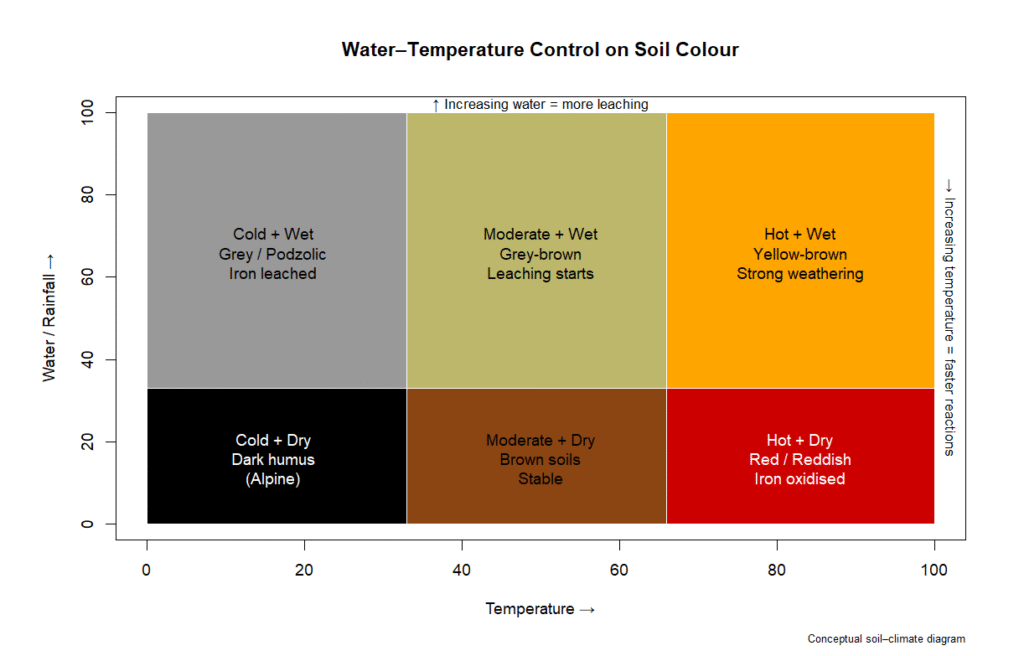
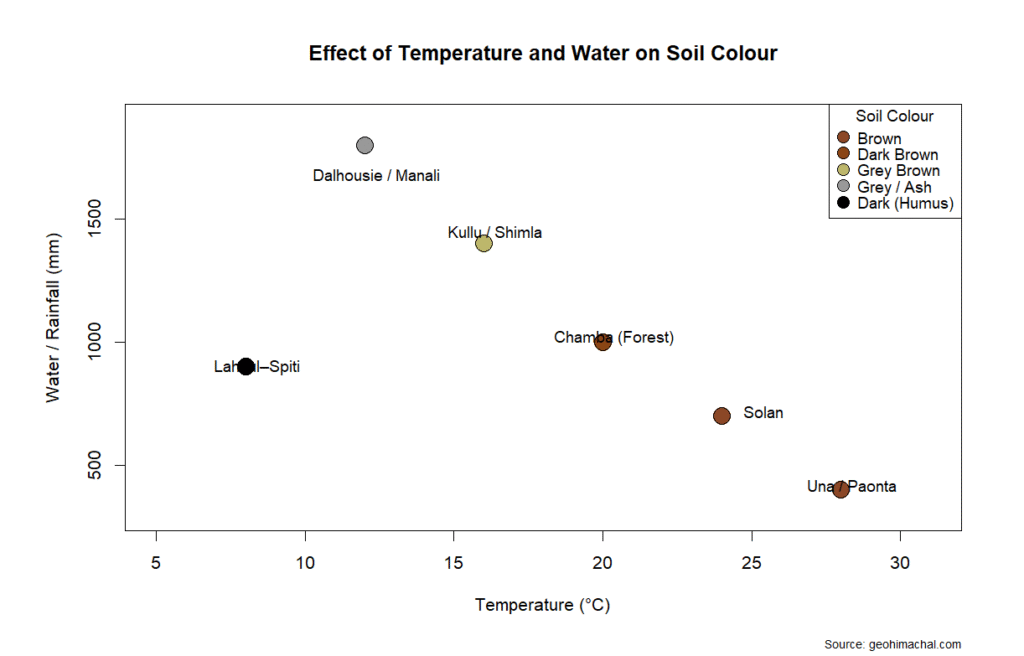
Thus there are two factors that mostly controlled the Soil Formation in Himachal Pradesh are Rainfall and Temperature. Temperature decides how much soil forms and water decides what stays or leaves. Forest also play important role in deciding Soil formation. For example
- If Temperature is High and Rainfall is Low Organic matter will Decompose well and Iron Stay as Brown Oxide. Such Brown Soil is found in Shivalik hills .
- If Temperature is low/Cool organic matter will not decompose well and if it rain high Iron will washed away and resultant soil will be Grey and Pale. Similarly if Temperature is very cool and no rainfall or little rainfall Soil become very Dark Brown due to presence of high iron content.
General Classification of Soil
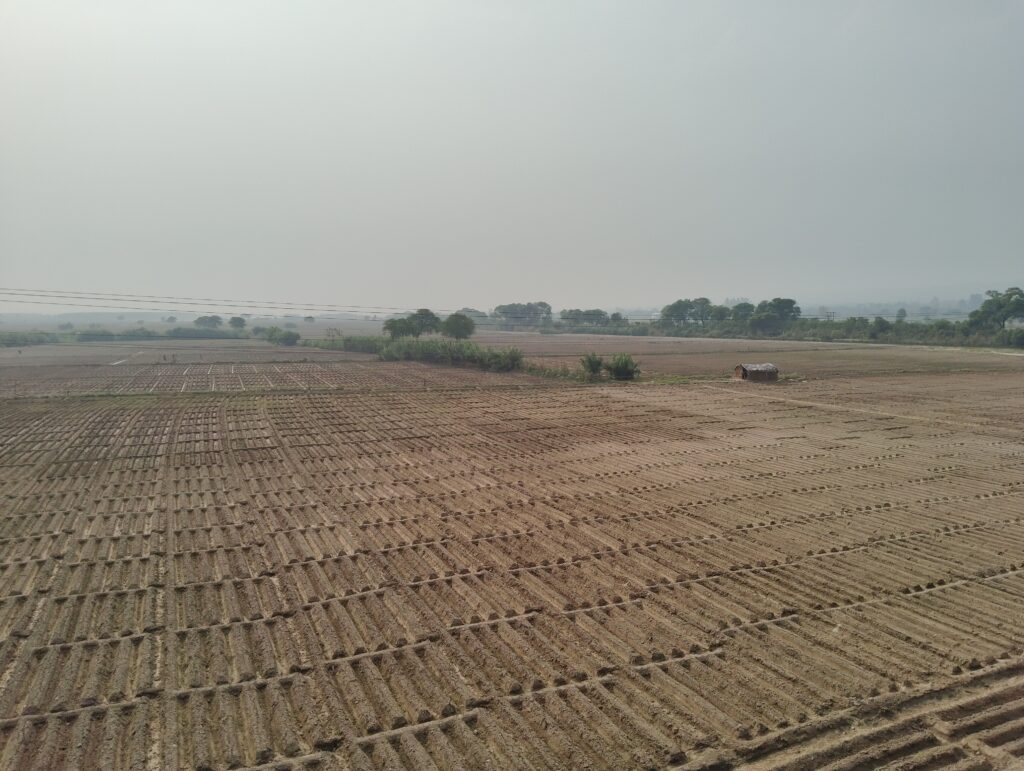
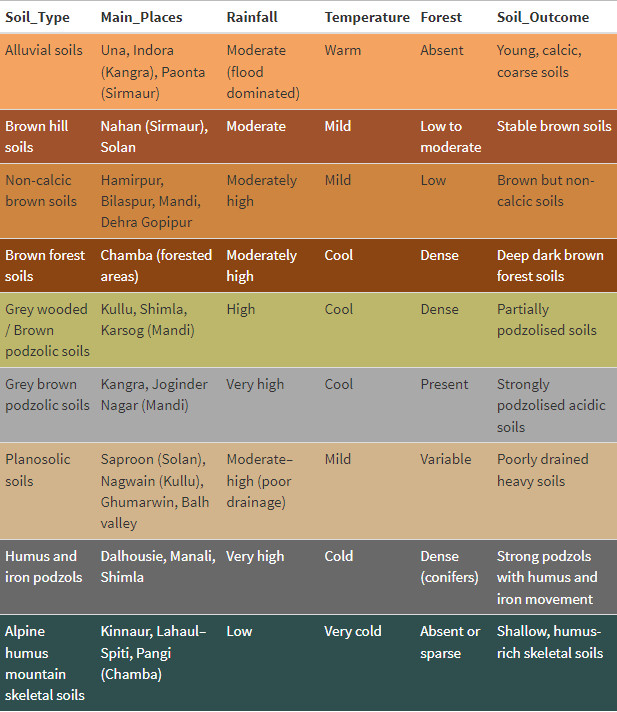
- Alluvial soils occur in the floodplain areas of Una, Indora in Kangra district, and Paonta in Sirmaur. In these areas rainfall is moderate and temperature is relatively high, but the key factor is river flooding. Water spreads laterally during floods and deposits fresh sand and silt every year, so soil formation is repeatedly interrupted. Because downward movement of water is weak, calcium is not washed out and remains in the soil, making the soils slightly alkaline. Warm conditions keep iron in an oxidized state, giving brownish colors, while low and seasonal vegetation results in low organic matter. As a result, these soils are young, coarse textured, low in humus, and weakly developed.
- Brown hill soils are found around Nahan in Sirmaur and Solan district, where rainfall is moderate and temperatures are mild. Water moves slowly down the hill slopes rather than strongly downward through the soil. This limited leaching allows nutrients and iron to remain in the soil, producing a stable brown color. Organic matter builds up at a moderate rate because of grass and scattered vegetation, which gives these soils a neutral to slightly acidic reaction. The balance between water availability and temperature allows steady soil development, resulting in well-formed but not strongly leached brown soils.
- Non-calcic brown soils occur in parts of Hamirpur, Bilaspur, Mandi, and Dehra Gopipur in Kangra district. These areas receive slightly higher rainfall than the brown hill soil zones, while temperatures remain moderate. The increased rainfall is sufficient to wash calcium out of the soil profile, which is why these soils are non-calcic. However, rainfall is still not high enough to cause strong leaching of iron or clay. Iron remains in the upper layers, maintaining a brown color, while the loss of calcium shifts the soil reaction toward neutral or mildly acidic. Organic matter remains low to medium because vegetation cover is not very dense.
- Brown forest soils develop in the forested areas of Chamba district under cooler temperatures and moderately high rainfall. Dense forest cover supplies continuous leaf litter, which increases organic matter and slightly acidifies the soil. Rainfall promotes downward movement of water, but not to an extreme degree, so nutrients are partly retained. Weathering is active under these conditions, allowing soils to become deep and well developed. Iron mixes with organic matter, producing a dark brown colour, while pH remains slightly acidic to neutral. These soils reflect a balance between forest influence, rainfall, and temperature.
- Grey wooded or brown podzolic soils are found in Kullu, Shimla, and the Karsog region of Mandi district, where rainfall is high and temperatures are cooler. Under dense forest cover, organic acids increase the mobility of iron and bases. Downward movement of water becomes stronger, initiating podzolization. Iron begins to move from the surface to lower horizons but is not completely removed. This partial leaching results in grey-brown surface colours and increasingly acidic soil reactions. These soils represent a transitional stage between brown forest soils and fully developed podzols.
- Grey brown podzolic soils occur in parts of Kangra district and the Joginder Nagar area of Mandi, where rainfall is very high and the climate is cool. Continuous and strong leaching removes most base cations and iron from the surface layers. As a result, the topsoil becomes pale or grey, while iron and clay accumulate in the lower horizons. The loss of bases makes the soil clearly acidic. These soils show advanced podzolization due to the combined effect of heavy rainfall, cool temperature, and forest influence.
- Planosolic soils are found in the Saproon valley of Solan, Nagwain area of Kullu, Ghumarwin in Bilaspur, and the Balh valley of Mandi. Although rainfall is moderate to high and temperatures are mild, soil development here is controlled mainly by poor drainage. A compact or clay-rich subsoil blocks downward movement of water, causing water to stagnate in the upper layers. Because leaching is limited, calcium is not fully removed and soil reaction remains near neutral. Reduced oxygen conditions affect iron, producing greyish colours, while organic matter accumulates to medium or high levels.
- Humus and iron podzols are mainly confined to cold and very wet areas such as Dalhousie, Manali, and Shimla. Low temperatures slow down the decomposition of organic matter, leading to the accumulation of humus. At the same time, heavy rainfall and strong organic acids cause intense podzolization, pulling iron and aluminium downward. The surface layer becomes ash-grey and strongly acidic, while the subsoil develops reddish or yellowish colours due to iron accumulation. These soils are the result of the combined effect of cold climate, heavy rainfall, and dense forest cover.
- Alpine humus mountain skeletal soils are found in the high-altitude regions of Kinnaur, Lahaul–Spiti, and the Pangi tehsil of Chamba district, where temperatures are very low and precipitation is limited. Cold conditions greatly slow chemical weathering, while sparse vegetation results in slow but steady accumulation of organic matter, giving the soils a dark colour. Limited rainfall means little leaching, so nutrients are not strongly removed. However, frost action, steep slopes, and erosion prevent deep soil formation, leaving soils shallow, stony, and skeletal despite relatively high organic matter at the surface.
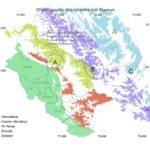
Classification of Himachal Pradesh Soil on the basis of Physiographic Division:
Low Hill Soils (up to 650 m altitude):-Low Hill soils in Himachal Pradesh, found at altitudes up to 650 meters, are greyish to yellowish-brown in color and have a texture ranging from loamy sand to sandy loam with embedded pebbles. These soils have a neutral pH and generally exhibit low to medium levels of organic content (OC), cation exchange capacity (CEC), and water-holding capacity (WHC). Common crops grown in these soils include wheat, maize, paddy, gram, mustard, potato, and sugarcane, along with various trees, shrubs, and grasses. Key regions with Low Hill soils include Una, Hamirpur, and parts of Bilaspur, Kangra, Mandi, Sirmaur, Solan, and Chamba.
- Mid Hill Soils (651 to 1800 m altitude) Mid Hill Soils (651 to 1800 m altitude):-Mid Hill soils are located between 651 and 1800 meters and typically range in color from dark yellowish-brown to dark brown, with a loam to clay loam texture. These soils are slightly to moderately acidic, with medium to high levels of organic content (OC), cation exchange capacity (CEC), and water-holding capacity (WHC). They support crops such as wheat, maize, barley, black gram, beans, paddy, and ginger. They are also suitable for quality seed production of temperate vegetables like cauliflower and root crops, and are conducive to tea plantations. Mid Hill soils are found in parts of Sirmaur, Solan, Bilaspur, Kangra, Mandi, and Chamba.
- High Hill Soils (1801 to 2200 m altitude) High Hill Soils (1801 to 2200 m altitude) :- High Hill soils are typically found at altitudes between 1801 and 2200 meters. They range from light to dark brown in color and have a sandy loam to silt loam texture with varying gravel content. These soils are slightly to moderately acidic, with medium levels of organic content (OC), cation exchange capacity (CEC), and water-holding capacity (WHC). The main crops cultivated in these soils include wheat, maize, barley, pseudo-cereals, and potatoes. They are also suitable for quality seed production of potatoes and various temperate vegetables. Regions with High Hill soils include Shimla, Kullu, and parts of Solan, Chamba, Mandi, Sirmaur, and Kangra.
- Mountainous Soils (above 2200 m altitude) :- Mountainous soils, found at altitudes above 2200 meters, typically consist of loamy sand to sandy loam with a gravel content. The color ranges from light to dark yellowish-brown, with a neutral to slightly alkaline pH. These soils usually have low to medium levels of organic content (OC), cation exchange capacity (CEC), and water-holding capacity (WHC). They support crops such as wheat, barley, and pseudo-cereals (e.g., buckwheat, amaranthus) and are also suitable for quality seed production of temperate and European vegetables. Mountainous soils are primarily found in the districts of Lahaul-Spiti, Kinnaur, and Pangi.
- Piedmont Plains: These plains are located at the foothills and have a moderate slope with coarse-textured soils, often containing gravels. These areas receive regular deposition of sediments from the rivers, which helps shape the soils. Flood Plains: These plains are created by the river such as such as the Swan and Bata depositing fine particles, such as sand, silt, and clay. Soils in floodplains can vary widely in texture, but they are typically alluvial soils with a high fertility due to constant sedimentation, making them more nutrient-rich and less sandy compared to other zones.
These zones receive fresh sediments every year, and as a result, the soils are often young and poorly developed, typically shallow and well-drained. The dominant soil types in these regions include Entisols and Inceptisols according to the USDA soil classification system.